
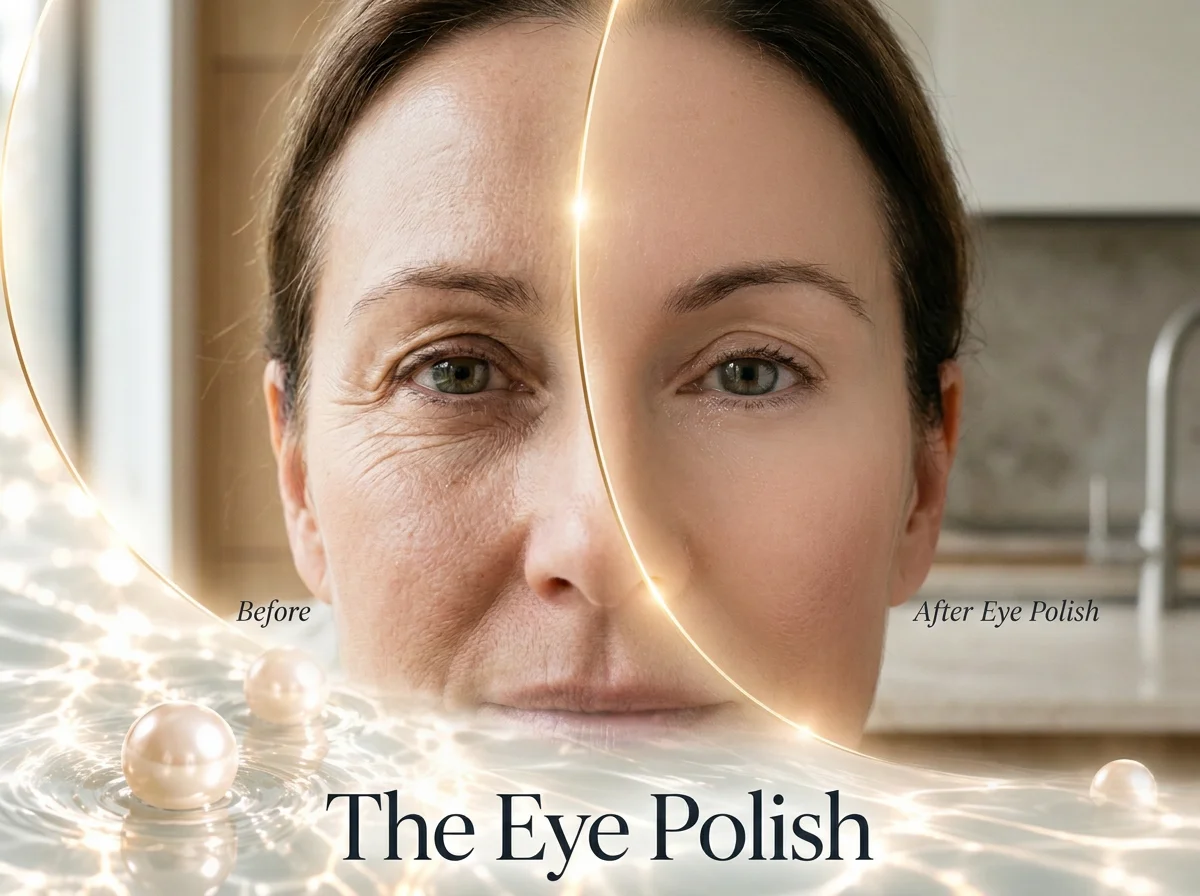
What if treating crow’s feet meant looking refreshed—not looking “done”?
There is a particular moment many patients describe during an aesthetic consultation.
They smile.
They like their smile.
But when they look closely at the outer corners of their eyes, they notice that the lines no longer disappear when the smile does.
At first, crow’s feet are usually dynamic—visible primarily when we smile, squint, laugh, or animate the muscles surrounding the eye. With time, repetitive movement combines with changes in collagen, elastin, hydration, sun exposure, and skin structure. Eventually, some of those lines begin to remain visible even when the face is completely relaxed.
And that raises an important question:
If a wrinkle has both a movement component and a skin-structure component, should we always treat it with only one tool?
At KESH MedSpa in Melrose, Massachusetts, that question inspired a signature treatment I call The Eye Polish.
-
Crow’s feet—also called lateral canthal lines—are wrinkles that develop around the outer corners of the eyes.
The orbicularis oculi muscle contracts every time you smile or squint. Early in life, the skin rebounds quickly after that movement. Over time, several things begin to change:
collagen production decreases;
elastin fibers become less resilient;
repeated UV exposure contributes to photoaging;
skin becomes thinner and less able to retain moisture;
repetitive facial movement gradually creates visible folding patterns.
That is why two people of exactly the same age may have dramatically different crow’s feet.
Genetics matter.
Sun exposure matters.
Smoking matters.
Skin thickness matters.
Facial anatomy matters.
And perhaps most importantly, how your face moves matters.
Which leads to the next question.
Are All Crow’s Feet the Same?
No—and this distinction is fundamental to thoughtful aesthetic treatment.
Dynamic crow’s feet These appear primarily when you smile or squint.
Botulinum toxin products such as BOTOX Cosmetic work by temporarily reducing muscle activity. BOTOX Cosmetic is FDA-approved for temporary improvement of moderate-to-severe lateral canthal lines, commonly called crow’s feet.
For a patient whose lines disappear almost completely when the face relaxes, neurotoxin alone may provide exactly the result they want.
But what happens when those lines do not disappear at rest? Those are different.
Static or etched lines
Static lines remain visible even without facial movement.
At this point, repetitive muscular folding has been joined by changes in the skin and underlying tissue.
This is where simply increasing the amount of neurotoxin may not necessarily solve the entire problem.
And that realization is where The Eye Polish begins . . .
-
The Eye Polish is KESH MedSpa’s individualized approach to treating selected patients with both: Dynamic crow’s feet. &. fine resting or etched lateral-eye lines.
The treatment may combine carefully planned neurotoxin treatment with a conservative amount of hyaluronic-acid filler when clinically appropriate.
The goal is not to eliminate personality from the face.
It is not to create a frozen smile.
And it is certainly not to make every patient’s eyes look identical.
The objective is much more refined:
“Soften repetitive movement where appropriate while selectively addressing fine lines that remain visible at rest.”
In other words: movement + structure = a more complete assessment
And that brings us to the question patients frequently ask next.
-
Because neurotoxin and filler do fundamentally different things.
Botulinum toxin decreases targeted muscular activity. Dermal filler, by contrast, is a structural injectable material.
Hyaluronic acid is a naturally occurring substance found within human tissues and has an affinity for water. In approved indications, hyaluronic-acid fillers can restore volume or soften selected facial wrinkles and folds.
But the important concept is not simply “Botox plus filler.”
It is matching the treatment mechanism to the reason the line exists.
If a line appears because muscle contraction folds the skin, muscle modulation may help.
If a fine line remains after the muscle relaxes, the skin and tissue may need a different strategy.
Sometimes the correct answer is combination treatment.
Sometimes it is neurotoxin alone.
Sometimes it is better skin care, resurfacing, microneedling, or another treatment entirely.
That is why the consultation matters.
-
Neurotoxin treats the movement that creates crow’s feet. The Eye Polish goes a step further by also addressing selected fine lines that remain visible at rest.
The benefit is not that the Botox lasts longer. Rather, the filler and neurotoxin work on different components of the wrinkle, so some improvement may remain even as the neurotoxin effect gradually wears off.
The result is a more complete approach: softer movement, smoother resting lines, and a refreshed look that still feels natural.
-
The patient I envision for this treatment often says something like:
“I don’t mind smiling. I just don’t like that the lines stay there afterward.”
You may be a potential candidate if you:
notice crow’s feet when smiling or squinting;
also notice fine lines at the outer eye when your face is completely relaxed;
want refinement rather than dramatic alteration;
prefer a natural-looking result;
understand that injectable treatment should be individualized to anatomy;
are medically appropriate for both neurotoxin and hyaluronic-acid filler.
But there is an equally important question.
Who may not need The Eye Polish?
Someone with purely dynamic crow’s feet may do beautifully with neurotoxin alone.
Someone whose primary concern is crepey skin, pigmentation, laxity, or overall photodamage may benefit more from a skin-quality strategy ~ like microneedling.
And some patients simply should not receive filler in this region.
At KESH, the treatment should follow the diagnosis—not the other way around.
That principle is central to how I want aesthetic medicine practiced.
-
Not completely.
Facial expression is normal, healthy, and part of being human.
But their progression can often be influenced.
And this is where prevention becomes more interesting than simply “start Botox early.”
The most important preventive tool is still sunscreen.
UV exposure accelerates collagen degradation and photoaging.
A broad-spectrum sunscreen, sunglasses, and avoidance of unnecessary cumulative sun exposure can make an enormous difference over decades.
Skin quality matters.
A well-designed skin-care program may include ingredients such as retinoids, antioxidants, moisturizers, and other evidence-based products selected for the individual patient.
Repetitive movement matters—but eliminating expression isn’t the goal.
Strategically reducing excessive muscle contraction in appropriate patients may decrease repetitive folding of the skin.
The objective should be movement management, not facial paralysis.
Lifestyle matters more than people think.
Smoking, nutritional quality, sleep, chronic stress, alcohol exposure, UV exposure, and general health all influence how tissues age.
This is where my interest in Lifestyle Medicine and regenerative approaches to healthy aging intersects with aesthetics.
Injectables can modify a line.
They cannot replace the biological foundations of healthy skin.
And that naturally leads to another important question.
-
Your treatment plan should not end when you leave the treatment chair. KESH can help you build a simple, targeted eye-care routine to support your results at home.
The Eye Polish Treatment → Addresses Dynamic + Selected Static lines
Medical-grade skincare Kit → Supports skin quality between treatments: SkinCeuticals A.G.E. Advanced Eye, ( Plated ) Exosome Serum , and Future Mineral UV Defense SPF or 50 Physical Fusion UV Defense SPF 50.
Daily sun protection → Helps reduce ongoing photoaging, by wearing sun protection such as a hat, sunscreen, and eye protection.
-
There is no correct age. I believe in treating anatomy.
A patient in their early thirties may already have prominent lateral canthal lines because of genetics, facial movement, and sun exposure.
Another patient in their fifties may have very little.
The better question is: What is happening to your skin when your face moves—and what remains when it stops?
That assessment tells us far more than age.
-
Treatment begins with a physical exam—not injection.
I evaluate the eye area:
at rest;
during smiling;
during squinting;
from multiple angles;
for baseline asymmetry;
for skin quality;
for the distribution of dynamic versus static lines.
Photographs are taken before treatment.
Then we determine whether combination treatment actually makes sense.
The visit is expected to take approximately 30 minutes, including assessment, photography, treatment planning, and injections.
The treatment itself is generally much shorter than the consultation surrounding it.
-
The two components behave differently.
BOTOX Cosmetic typically begins producing visible effects over the first several days, with the result continuing to develop over approximately the following two weeks.
The FDA-labeled lateral-canthal treatment uses injections into the lateral orbicularis oculi muscle; treatment plans can be individualized clinically.
Hyaluronic-acid filler produces an immediate physical change, although early swelling can temporarily influence its appearance.
For that reason, I generally prefer to evaluate the overall result at approximately two weeks.
Which brings us to one of the questions patients care about most.
-
That is the entire point.
The best aesthetic result should make someone think: “You look rested.”
Not: “What did you have done?”
The goal of The Eye Polish is not an expressionless eye.
It is to preserve the warmth of the smile while softening the features that may be making the eye area look more tired or aged than the patient feels.
That philosophy is very much part of KESH: Refinement instead of Reinvention.
-
Most patients should expect relatively little interruption to normal activities, although injectable procedures can cause:
redness;
tenderness;
swelling;
pinpoint injection marks;
bruising.
The lateral eye contains delicate skin and substantial vascular anatomy, so bruising can occur even when treatment is performed carefully.
Dermal fillers have additional risks, including inflammation, nodules, infection, vascular occlusion, tissue injury, and rare but serious complications involving vision. FDA specifically warns that accidental intravascular filler injection can result in skin necrosis, stroke, or blindness.
That is precisely why provider training, facial anatomy, patient selection, complication preparedness, and informed consent matter so much.
-
KESH is being built around something different.
KESH approaches facial aesthetics as medical assessment first and procedure second.
That means considering:
facial anatomy;
movement patterns;
skin quality;
proportions;
aging biology;
treatment sequencing;
patient goals;
complication prevention;
and long-term skin health.
KESH MedSpa is a boutique medical aesthetics and wellness practice in Melrose, Massachusetts, designed for patients from Melrose and surrounding communities who value individualized care with natural results rather than high-volume injectable treatment.
Refreshed eyes. A more radiant you.
The Eye Polish was created for patients who want their eyes to look refreshed while still looking unmistakably like themselves.
At KESH, treatment begins with an individualized evaluation of your facial movement, skin quality, anatomy, and goals.
“Beautiful results should soften the evidence of time without erasing the story in your expression”
KESH Medspa serves patients in Melrose and surrounding communities including Stoneham, Wakefield, Malden, Medford, Reading, Saugus, and the North Shore.